Inside the Rossdale Power Plant Edmonton
The Rossdale Power Plant has been an omnipresent structure in the Edmonton river valley that can be easily disregarded if you’re not paying attention when driving by but would be noticeably absent if it ever ceased to be. (You can peep it in the background of my Double Denim outfit post from a few years ago.) Thankfully, it’s on the National Trust for Canada list so it’s here to stay. With that said, every building in Edmonton has a story that begins long before it’s construction.

ROSSDALE POWER PLANT LOCATION
The very grounds around the present day plant were a fundamental spot to the Papaschase band, other First Nations, and later Métis people. Thousands of years prior to its development by settlers, this area of land was regarded as pehonan, which is a Cree word meaning ‘a gathering place’. Now known as the Rossdale Flats, this neighbourhood was the location of the original Fort Edmonton and Hudson’s Bay Trading Outpost. Naturally, this included a cemetery.

A SACRED BURIAL GROUND
In the early 2000s, Epcor had plans to expand their facility but rightfully received major pushback. Firstly, to preserve the historical building then also from the Papaschase band who wanted the area recognized for the burial ground it is. Unsurprisingly, the first argument won out and was able to halt the expansion. However, this decision had additional benefits beyond architectural preservation. It also assisted the Papaschase band in securing an official burial ground.

It’s wild to me that the impetus for recognizing the importance of this sacred stolen land was only achieved as a sequela to saving a historic building. Though it was an overall victory, Indigenous people shouldn’t have to wait until their interests coincide with another cause in order to get what is rightfully theirs in the first place.

THE FIRST POWER PLANT
Prior to the Rossdale Power Plant we know today, there was another electricity generating station there. In the late 1800s The Edmonton Electric Lighting and Power Co operated a small power plant on the banks of the North Saskatchewan River. This private company was owned by Alex Taylor who I can only speculate acquired the land in some nefarious way because COME ON. How does one get such a plum piece of land?
In 1902 he sold the company to the city of Edmonton for $13,000. Through the Bank of Canada inflation calculator, I made an attempt to get a number in today’s dollars but it only has data from 1914 onward. My best guess would be somewhere above the $350,000 range based on the 1914 data.

ARCHITECTURAL HISTORY OF THE ROSSDALE POWER PLANT
Architecturally, the Rossdale Power Plant is an artfully executed frankenstein building. Though not immediately obvious, each subsequent section was added on over time. The six phases of its expansion started in 1931 and ended in 1955. The largest structure, the low pressure plant, (which includes the turbine house and boiler room) was designed by architect Maxwell Dewar.

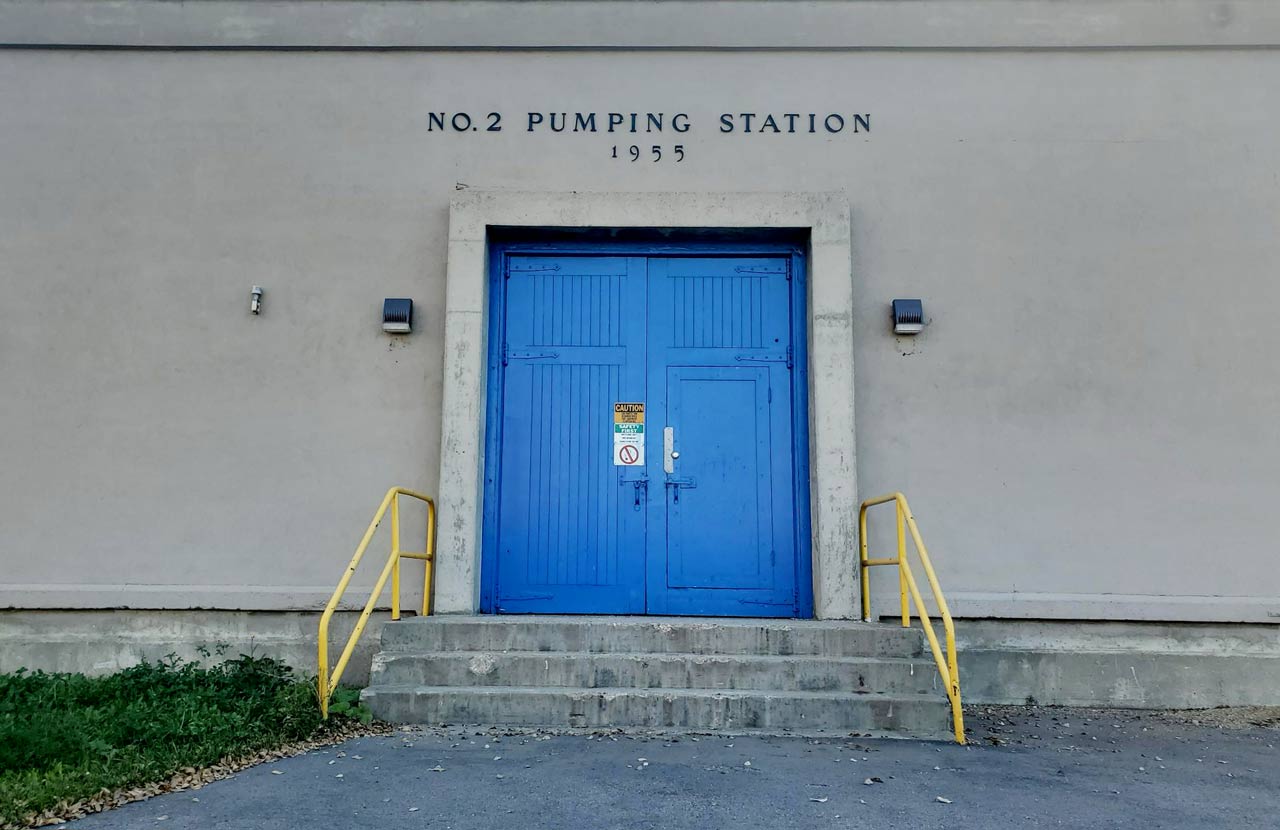
Adjacent to the North Saskatchewan river are the two pumping stations the first of which was built in 1938. The second one, located closest to the Walterdale Bridge, was built in 1955. It’s unclear whether the second pump house is part of the historical designation. In addition to those structures there’s also an administration building.

THE FUTURE OF THE ROSSDALE POWER PLANT
Over the years many ideas have been put forth reimagining what the plant could be used for in this next stage of its life. Rossdale ReGeneration has a website that began documenting the progress as well as suggesting recommendations for the site over the past decade. They’re a local group comprised of architects, neighbours, and historic enthusiasts.


Most recently the Calgary based architectural firm MBAC has been conducting assessments on the plant for future rehabilitation options. Marc Boutin, the founder of MBAC, was one of the guides on the Edmonton Design Week tour of the Rossdale Power Plant. He’s also in charge of the Hawrelak Park Rehabilitation which I have my eyes on. I deeply fear that the organic modernist Bittorf and Wensley designed pavilions will be gone upon completion or horribly mutilated. I can only hope that my suspicions are incorrect.

INDUSTRIAL PAST MEETS PRESENT USAGE
Though the process feels never ending, I’m still excited to see what comes of the plant in the future. The space is impressive inside as it is outside. From the layers of catwalks to the building materials aged by industry, each aspect feels too good to alter. I would love to see the industrial nature of the building celebrated rather than sanitized and covered up.


The Tate Modern in London comes to mind as a prime example. I was optimistic about the Battersea Power Station but it has sadly become yet another temple of capitalism. Though I still plan on seeing it in person because I’m curious. What would your best case scenario be for the final usage plans of the Rossdale Power Plant? Were you intrigued by the thermal bath plans, the theatre venue, or something else?
EDMONTON DESIGN WEEK
Many thanks to Edmonton Design Week for hosting me on this wonderful tour.
I was also able to attend a tour of The Galleria condos with Edmonton Design Week. The residential building was designed in the 1980s by Patkau architects. If you’re curious about the interior, I recommend checking out the post.
photographs – jesse sand + sandy joe karpetz
SUBMIT A COMMENT
MORE ARCHITECTURE POSTS


0 Comments